Questions
- What is the difference between old growth (unlogged) forest and second growth logged forest?
- Why does the marbled murrelet require old growth for nesting?
- What is the value of old growth forest that should inform our forestry practice?
- What kind of research is being done at the Bamfield Marine Science Centre?
Field trip to the BMSC – Prof. Maria Morlin, Vancouver Community College
Driving from Port Alberni to Bamfield, B.C., the location of the BMSC, and the beginning of the West Coast trail of the Pacific Rim National Park, is not arduous anymore, because the road has been graded, or chip filled I think they call it. It is 87 km from Port Alberni. Along the drive, second growth and clear cuts line the road. There is no sign of old growth forest in this area.
Bamfield is on Vancouver Island, and 79 of the 79 watersheds on Vancouver Island have been logged. I know. I did my master’s thesis on coho declines and habitat in 16 watersheds in the Georgia Basin. These watersheds drain in the Salish Sea (Georgia Strait). I had to use aerial photos from the 50’s and 70’s and orthophotos from the mid-90’s to collect land use data. Now you just have to look on google maps satellite images. But you can’t always tell from the images whether forest is old growth or second growth. That’s why you do something called ‘groundtruthing,’ where you go to your various satellite locations and verify it is what you think. I did that in 16 watersheds, and the old growth was very, very scarce back then – and that was in the mid 90’s. It has all but disappeared now, and greedy exploiters want the rest. Don’t let them have it!
It is difficult to convince people there is a difference between second growth and old growth, but trust me there is a huge difference. On this particular excursion, I am gathering photos so you can see what an old growth forest looks like. Second growth you can see everywhere. Stanley Park, the mountains around the Lower Mainland, all of the Gulf Islands, and of course almost 100% of Vancouver Island. Logging is now for second growth forest for the most part.
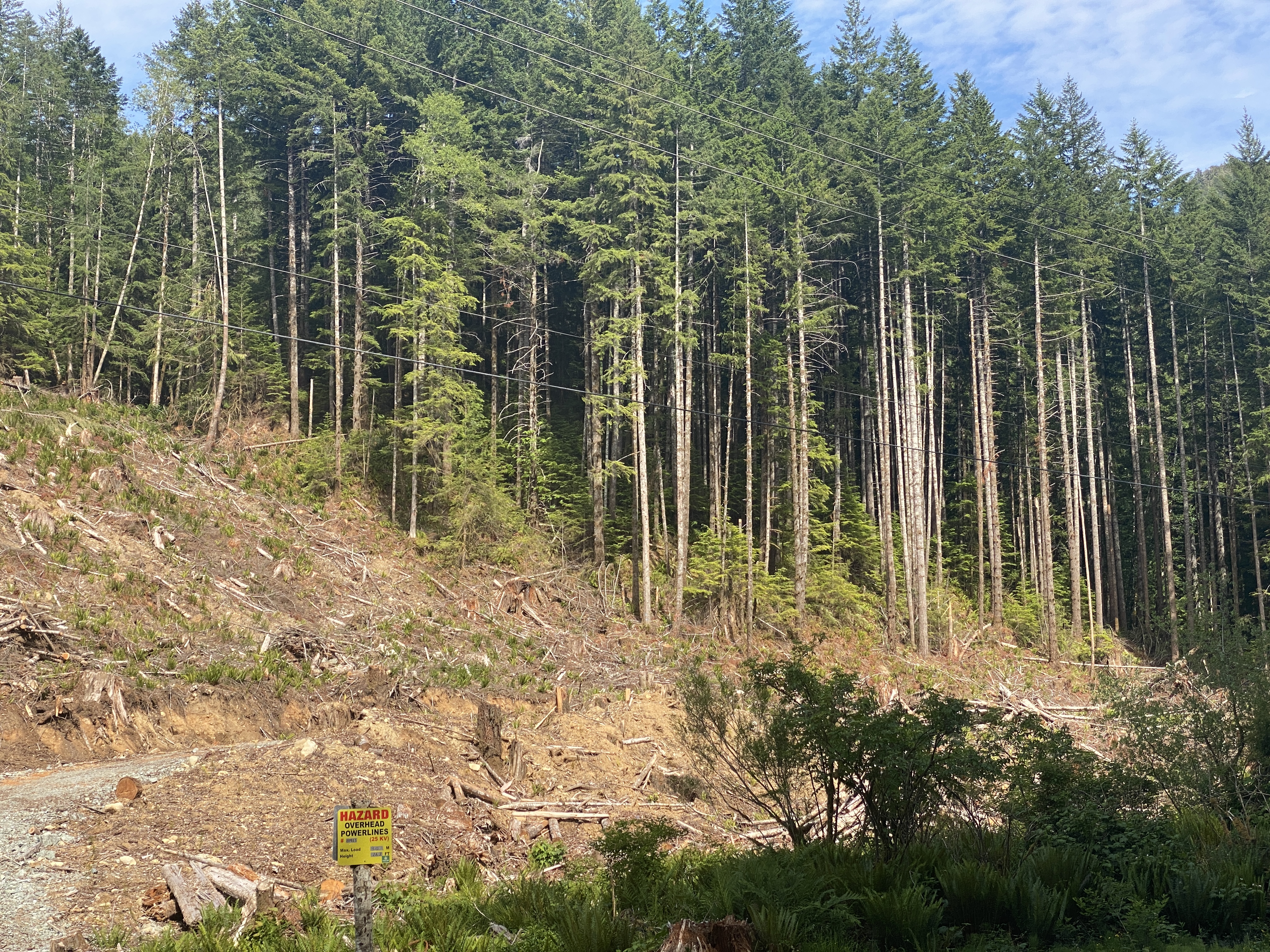
Below is a photo of second growth adjacent to a cut block. The trees are the same height and circumference, which is typical of planted trees after logging. They are planted at the same time, therefore the resulting forest is very uniform. Quite different from a pristine forest, which has enormous diversity of tree species, sizes and understory.
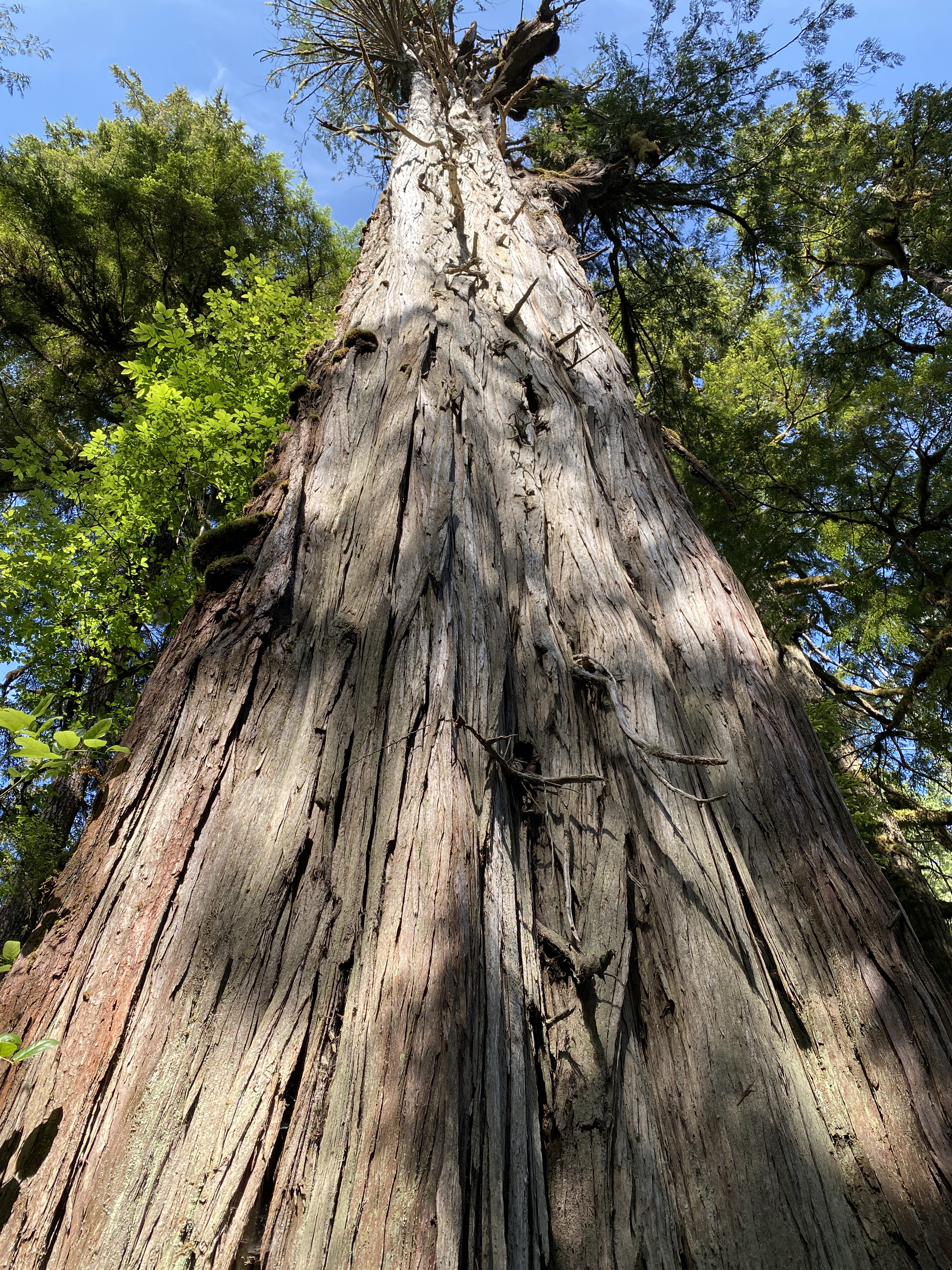
Old growth – let’s call it pristine forest for the sake of my friend Alistair – has these big, big trees. Like this cedar for example. Stringy bark, wide girth. You can tell the age of a tree by taking its diameter at breast height (DBH). I did not have a tape measure, but it’s definitely older than 300 years. This was on a short trail from the marine station road to a little beach called strawberry point on account of there are strawberries growing on the rocks there. I saw a green and black striped snake. The forest is damp here. Very damp. That’s because an old growth pristine forest retains water. Why? For one thing, trees take up water from the ground. Enormous trees – loads of water. Then they evapotranspirate it into the air. Causing – you guessed it – rain. It’s very rainy here. Often a fine mist hangs in the air. Also of course it’s shady under the canopy. Also, there are TONS of mosses, hornworts and liverworts – all non-vascular plants highly in need of water – particularly for reproduction (their sperm has to swim through water to get to the egg). So the forest is wet. That makes it less susceptible to forest fires, and if there is a fire, survival is very likely of many of the big trees in particular.
One thing a forestry person may tell you, and I’ve heard this many times, is that more carbon dioxide is taken up by second growth forests because they are growing. Codswollop! That means nonsense. Leaves and needles take up carbon dioxide for photosynthesis. The leaf/needle surface area of an old growth pristine forest is much, much larger than a second growth one. Look how big the trees are for one thing. Also, don’t forget that plants, including trees, have indeterminate growth. That means they grow forever, unlike animals. On top of that, the moss and lichen coverage of a wet, old forest is much greater as well and of course these organisms photosynthesize. So welcome to a pristine old growth forest – a veritable sink for carbon dioxide. CO2. A pesky molecule causing pesky global warming, causing forest fires galore. You can see why old growth forest should be preserved. NOT CUT DOWN.
For the sake of the planet, forests have to be managed much better. Since the huge forestry multinationals are making all the money from OUR forests – they are responsible for being, well, responsible. They are responsible for mitigating fires. I’m tired of taxpayers having to cover for the mismanagement of forests by industry.
That includes fishing – a topic for a bit later. To come…more old growth forest photos.
 VCC Biology - Instructor Maria Morlin